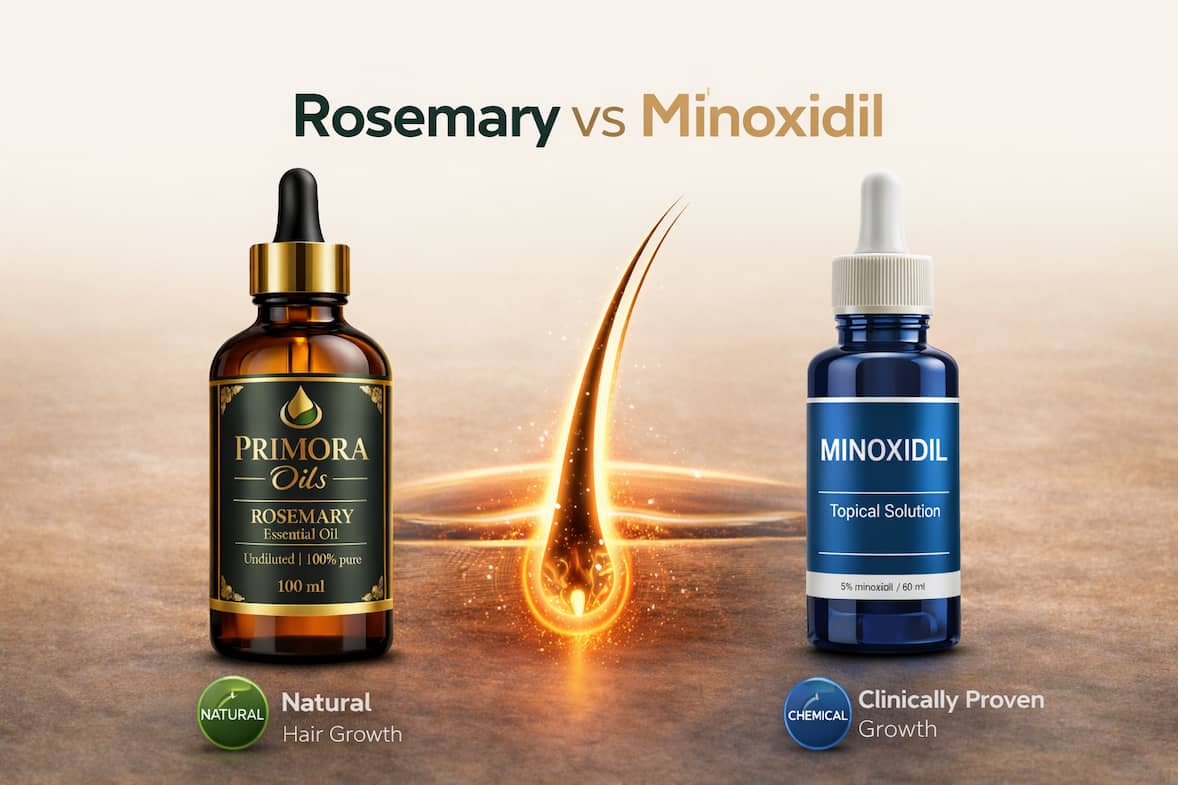
Rosemary oil is probably the most discussed natural option in hair-growth conversations today. That interest is not baseless. There is real preclinical and clinical discussion around rosemary. But the current evidence does not place it on the same footing as minoxidil, and a premium brand should say that clearly.
Why rosemary is discussed so often
Rosemary entered the hair-growth conversation for two main reasons. First, preclinical work suggested that rosemary leaf extract could promote hair growth in experimental models. Second, a small comparative clinical study later brought it into the same conversation as 2% minoxidil.
That combination — mechanism plus a recognizable comparison — is why rosemary became culturally important in the hair-loss space.
But cultural importance is not the same as evidentiary depth.
What the clinical evidence currently supports
The most widely cited human comparison is a small randomized trial later summarized in reviews: 100 participants with androgenetic alopecia were assigned to either topical rosemary oil or 2% minoxidil for six months. Both groups reportedly showed significant increases in hair count at six months, without a statistically significant difference between groups, and scalp itching was reported more often in the minoxidil group.
That is the result people repeat online — and it is not meaningless. But it is still one small study, not a full evidence platform.
More recent reviews continue to describe rosemary as promising, but they do not upgrade it to the status of a fully established replacement for minoxidil.
Why minoxidil still sits in a different category
Minoxidil has a much broader clinical and regulatory foundation. It is FDA-approved for androgenetic alopecia, widely recommended in dermatology practice, and supported by a much larger treatment literature than rosemary oil.
Dermatology guidance also emphasizes that minoxidil may take months to show benefit and works best with consistent use. That kind of guidance exists because the evidence base is deeper and more mature.
For a serious brand, the correct message is not rosemary instead of minoxidil. The correct message is rosemary versus minoxidil is a real comparison worth understanding — but not an equal-evidence comparison.
How to write about rosemary honestly and well
The premium way to present rosemary is as a botanical option with promising early evidence, a strong consumer profile, and a sensory ritual many customers enjoy.
That is very different from promising that it works as well as minoxidil for everyone or that it can replace medical care.
If you want credibility, frame rosemary as a researched botanical comparison point — not as a miracle.
References
- AAD: Hair loss diagnosis and treatment.
- AAD: Male pattern hair loss treatment.
- AAD: Female pattern hair loss treatment.
- Gupta et al., 2022. Minoxidil: a comprehensive review.
- Rosenthal et al., 2024. Management of androgenic alopecia: a systematic review.
- Rubaian et al., 2024. Natural alternatives for androgenetic alopecia, with emphasis on rosemary oil.
- Ufomadu et al., 2023. Review of dermatologic effectiveness for androgenetic alopecia.
- Murata et al., 2013. Promotion of hair growth by Rosmarinus officinalis leaf extract.