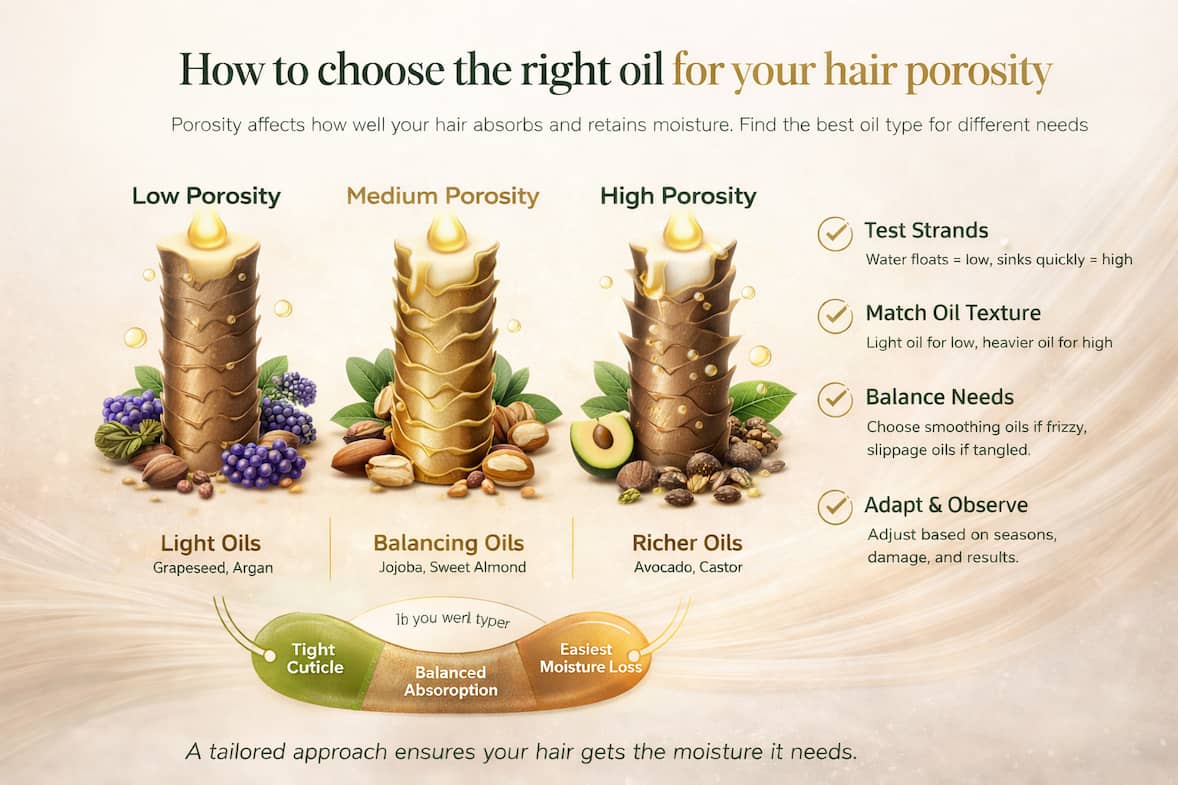
Choosing an oil well is not only about ingredients. It is also about how your hair absorbs, retains, and reacts to what you apply. "Hair porosity" is useful consumer language because it helps describe differences in absorption and moisture behavior, but it works best when paired with texture, damage history, and routine fit rather than used as a rigid label.
What porosity is really describing
In practical terms, porosity describes how readily hair takes in and releases water and cosmetic ingredients. Hair that resists wetting, dries slowly, or feels easily weighed down is often described as lower porosity. Hair that absorbs quickly, frizzes easily, or loses softness fast is often described as higher porosity.
This language is useful because it translates everyday hair behavior into product decisions. It helps explain why one person finds an oil beautifully smoothing while another finds the same oil heavy, flat, or short-lived.
That said, premium guidance should avoid pretending that porosity alone decides everything. Hair fiber diameter, chemical processing, heat exposure, styling habits, and wash frequency all influence how an oil feels in real use.
Why not all oils behave the same way
Oils differ in molecular profile, spreadability, sensory finish, and how much they remain on the surface versus move more deeply into the hair fiber. One of the clearest examples in the research literature is coconut oil, which has been shown to reduce protein loss from hair more effectively than mineral oil or sunflower oil in a classic cosmetic-science study.
Newer work has also linked coconut-based oils with reduced increases in hair porosity under experimental conditions, suggesting that repeated use may help support fiber integrity in some settings.
This does not mean every hair routine needs coconut oil, nor does it mean other oils are useless. It means premium recommendation should be specific: some oils are better at internal fiber interaction, while others are better used for surface smoothness, slip, shine, or a lighter finishing feel.
A better way to choose by feel, not hype
If your hair feels coated quickly, falls flat, or looks oily before it feels nourished, start lighter and use smaller amounts. If your hair seems to absorb product quickly and still feels rough or dry later, a richer oil or longer-contact ritual may make more sense.
The best premium routine is not the most dramatic one. It is the one that matches your real pattern of use: pre-wash, overnight, scalp massage, or soft daily finishing.
A useful rule is to choose for compatibility first, claims second. The right oil should feel like it belongs in your ritual.
How Primora should frame this on-site
On a premium site, porosity guidance should feel consultative rather than diagnostic. Avoid language that sounds medical or overconfident. Use it to help customers understand weight, finish, and routine fit.
That means describing oils in terms such as lighter, richer, more smoothing, more cushioning, better for pre-wash use, or better for porous and rough-feeling hair.
When written with restraint, porosity guidance makes a luxury brand feel selective, intelligent, and trustworthy.